If you cannot see the newsletter properly, click here |
|
|
FIRST DELIVERABLES AVAILABLE |
|
|
Following the end of the project's first year, the first three deliverables of the project were made available to the public . A brief overview of these deliverables is provided below.
You may visit the B5G-Open website for further details. |
|
|
Infrastructure Control and Service Management architecture, initial requirements, and existing frameworks CTTC, TID, UC3M, TIM, INF-P, ADVA SE, NBLF, CNIT, CNR, UPC, OLC-E, ELIG, TuE, PLF
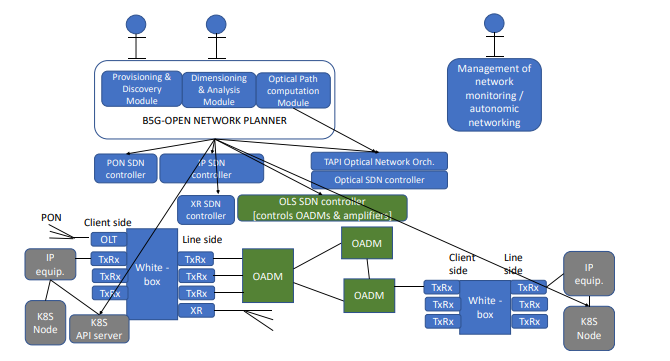
This paper includes a list of preliminary needs, current frameworks, and a detailed description of the Infrastructure Control and Service Management platform architecture that will be used in the B5G-OPEN Control, Orchestration, and Telemetry System (also known as the control plane). The suggested control plane architecture, represented in the above diagram, is thoroughly described in the publication. The architecture's main components include service orchestration and planning, packet optical integration systems, telemetry, and intent-based networking. |
|
|
First year results on data plane
infrastructure
TID, TIM, BT, ADVA, NOKIA, CNIT, CTTC, INF-P, INF-D,
HHI, OLC-E, TUE, PLF This deliverable summarizes WP3's first year of project activities. The following goals guided the division of the work into separate activities: - The development of a cutting-edge optical transport infrastructure that supports MB connection and a transparent network continuum, possibly extending from user equipment to data centers.
-
Modeling the performance of traffic and transmission for the chosen MB data plane options.
- New optical network devices for switching, amplification, and transmission are designed, prototyped, and experimentally evaluated.
-
Examining and putting to the test new optical technologies for 5G X-haul, MB PON, and Point to Multi-point (PtoMP) with low costs and power consumption.
-
In order to maximize bandwidth and ensure smooth handover, fiber should be designed and tested for optimal integration with LiFi systems that offer multicell simultaneous transmission.
-
Creating, testing, and developing cutting-edge monitoring solutions to enable effective and adaptable utilization of the infrastructure.
|
| Definition of use cases,
requirements, and reference
network architecture TID, UC3M, TIM, BT, CTTC, CNIT, UPC, OLC-E, ELIG, PLF, INF-P, INF-G
Reporting on WP2's first year of project activities is this deliverable. In order to accomplish the following goals, the work was divided into two activities: -
Generating generic and more detailed use case definitions, service requirements, and network architecture that will serve as project guides.
- Offering reference network topologies and architecture for the project's experimentation and performance assessment.
These goals have been entirely met, and the B5G-OPEN network concept has been thoroughly defined. As a result, a clear framework has been established upon which the activities in the other technical work-packages can be built and guided.
One of the primary components is the definition and explanation of the project's key features, including multi-band (MB) operation, optical continuum (which is strongly related to the idea of a domain-less network), integrated access, E2E network orchestration, and autonomous operation. |
|
|
This project is supported by the European Union’s Horizon 2020 research and innovation programme under grant agreement No. 101016663 (B5G-OPEN) |
| Grant Agreement Number: 101016663
Status: Active
Start Date: 01 Nov 2021
Duration: 36 months
Budget: €5.465.068,75
Call ID:H2020 ICT-52-2020
Type of Action: RIA (Rersearch and Innovation Action) |
| This project is part of 5G PPP Phase 3, Part 6: 5G innovations for verticals with third party services & Smart Connectivity beyond 5G |
|
|
|